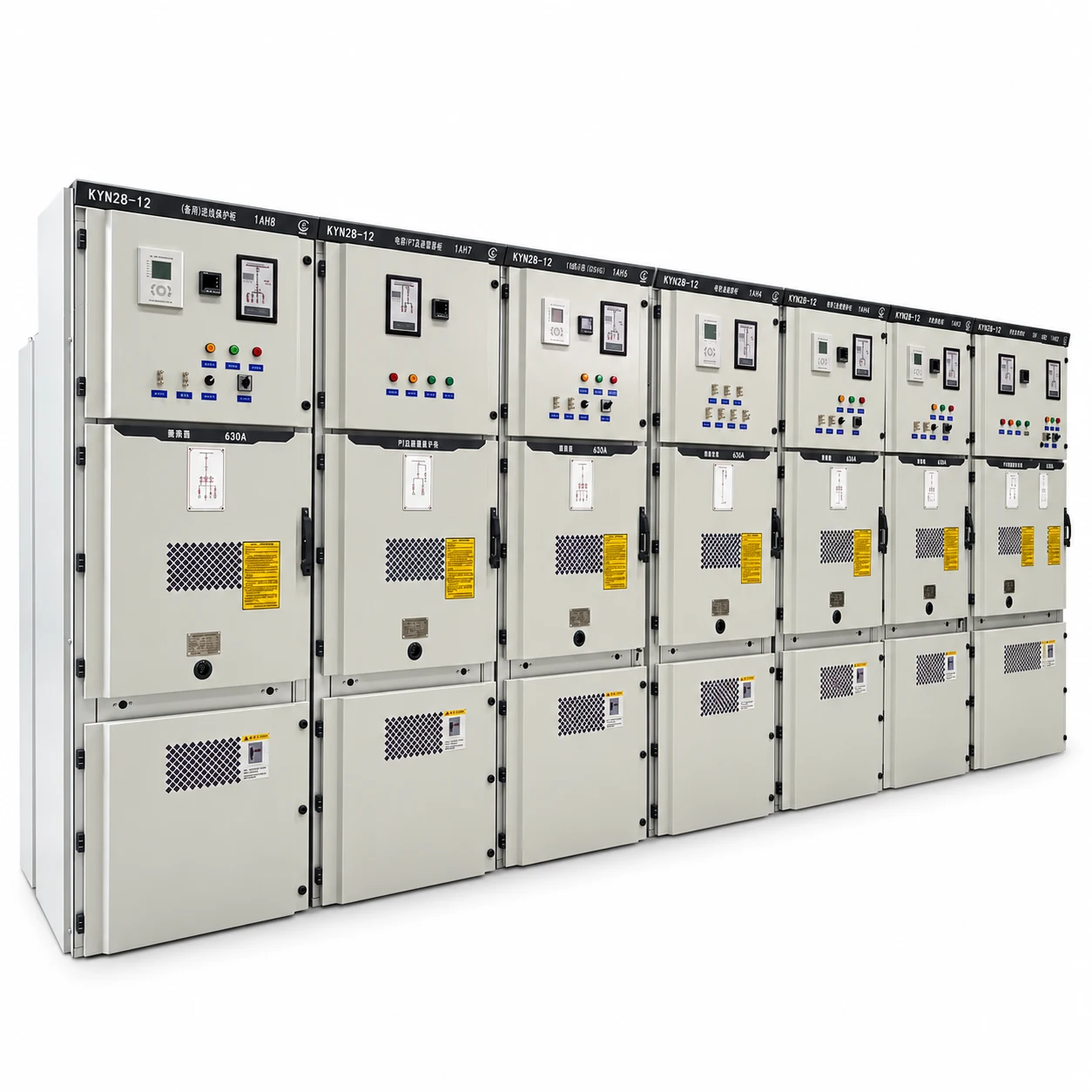
Header image: KYN28A-12 switchgear. The model-specific ratings are listed on its product page.
A 10 kV system voltage and 12kV switchgear can describe the same project at different levels. The first identifies the network’s nominal voltage; the second identifies an equipment rating. They are not competing names for one number, and the 12 kV label by itself does not establish project suitability.
This distinction matters when a drawing calls for a 10 kV network while a switchgear data sheet lists 12 kV. Compare the quantities and the complete specification before treating the difference as a contradiction.
Keep four voltage quantities separate
| Quantity | What it describes | What to check |
|---|---|---|
| System nominal voltage | The designated voltage of the electrical network, such as 10 kV. | The project single-line diagram and utility or design specification. |
| Equipment rated voltage | The voltage rating assigned to the selected switchgear, such as 12 kV. | The exact equipment variant and its applicable specification. |
| Power-frequency withstand voltage | An insulation withstand level under stated test conditions. | Test duration, circuit and whether the value applies phase-to-earth or across an isolating distance. |
| Lightning impulse withstand voltage | An insulation withstand level for a specified impulse test. | The stated test conditions and the applicable insulation coordination requirements. |
A withstand value is not a continuous operating voltage. Similarly, a higher insulation-related number must not be substituted for the required current rating, frequency or short-circuit capability.
Why use 12kV switchgear on a 10 kV system?
A network’s nominal value is not its entire operating envelope. Equipment selection must accommodate the project’s specified voltage conditions and insulation requirements. A design may therefore specify equipment with a 12 kV rated voltage for a nominal 10 kV system, subject to the applicable design and equipment requirements.
The correct conclusion is configuration-specific: verify the project’s highest operating voltage, the selected equipment rating and the required insulation levels. Do not infer that every product marked 12 kV is approved for every 10 kV or 11 kV installation.
How to read the Kaiyue product tables
- KYN28A-12: read the selected 12 kV variant independently of any separately listed higher-voltage series option. Busbar current and fault-duty options must also match that variant.
- HXGN-10: the series/model name and the table’s 12 kV equipment rating refer to different identifiers. Keep load-switch and switch-fuse columns separate.
- HBW-10 package substation: transformer high/low-voltage choices and the medium-voltage load-switch rating describe different components. Coordinate them using the complete substation diagram.
- DFW2-12/630 cable branch box: distinguish cable-connection arrangements from switch-equipped configurations. A switch rating is not automatically the rating of every optional component.
Voltage is only one part of equipment selection
Confirm the network frequency, busbar and feeder currents, prospective short-circuit current and required withstand duration. Peak withstand and short-time withstand are different quantities. Match the protection, earthing and cable-termination interfaces to the approved electrical scheme.
Review ambient temperature, humidity, altitude and pollution conditions in a separate service-condition check. These environmental thresholds can affect the selection, but they are not alternative values for rated voltage or current. Any special conditions should be included in the technical agreement.
Can the same equipment be used on an 11 kV network?
The 12 kV marking alone is insufficient to answer. The complete equipment variant must be reviewed against the network’s specified maximum voltage, insulation coordination, frequency, fault duty, service conditions and destination requirements. Request a configuration-specific confirmation rather than rewriting a 10 kV product page as an unconditional 11 kV offer.
Can a different voltage version be assumed from a series name?
No. A separately listed series option does not show that every current, protection arrangement and short-circuit rating is available at that voltage. Ask for a single, consistent technical schedule identifying the offered configuration. Missing values should remain pending until confirmed.
Information to send for a voltage review
- Nominal network voltage, highest operating voltage and frequency.
- Single-line diagram, incoming supply details and earthing arrangement.
- Required insulation levels and the project’s applicable specifications.
- Busbar/feeder currents, prospective fault duty and required duration.
- Indoor/outdoor service conditions, destination and required approval documents.
Start with the medium-voltage catalogue or package substations. The enquiry checklist and FAT checklist help carry the selected voltage data into the quotation and acceptance documents. Send the project specification for review.
References and scope
The sources below explain general engineering terms and inspection practice. Product ratings on this website come from the corresponding model documentation; another manufacturer’s catalogue does not establish Kaiyue equipment ratings.