
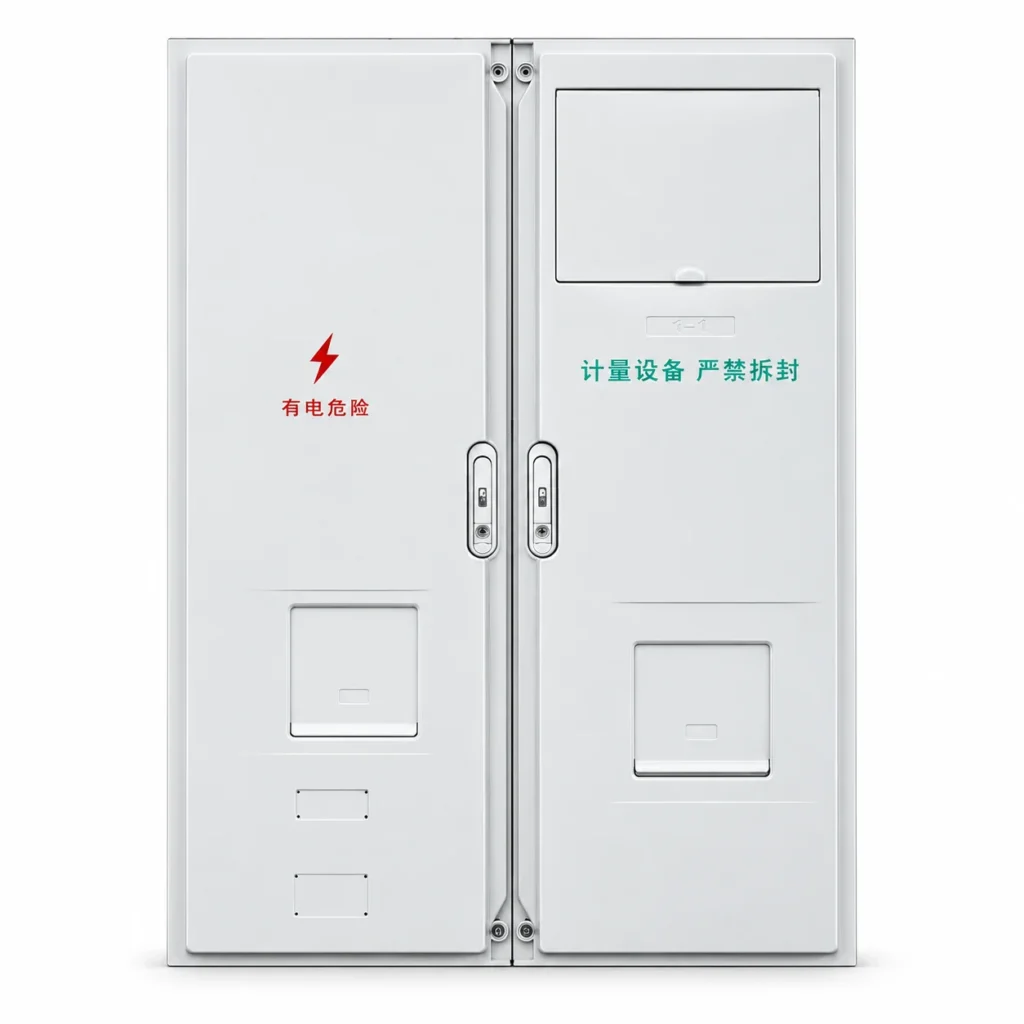
XMJ Metering Cabinet is a low-voltage metering family for energy measurement and associated distribution circuits. Specify the metering arrangement, incoming and outgoing duties, interfaces and corresponding configuration documents.
XMJ Metering Cabinet Specifications
Documented Variant Data
| Variant | Operating voltage | Cabinet rated current |
|---|---|---|
| XMJ-20 | 220 / 380 V AC | 20 A |
| XMJ-600 | 220 / 380 V AC | 600 A |
Functions and Service Conditions
| Parameter | Specification / configuration |
|---|---|
| Rated frequency | 50 Hz |
| Metering | Single- or three-phase metering according to the circuit scheme |
| Access | Meter observation and sealing arrangement selected for the project |
| Installation | Indoor |
| Maximum ambient temperature | +40 °C |
| 24-hour mean temperature | Up to +35 °C |
| Altitude | Up to 2000 m |
| Relative humidity | Up to 50% at +40 °C or 90% at +20 °C |
Ratings and options apply to the selected configuration. The agreed drawings and equipment schedule define the supplied assembly.
Coordinate the measurement scheme
The incoming circuit, energy meter and any current transformers have different electrical duties. The required meter type, transformer ratio, accuracy and connection arrangement should be specified for the project. A cabinet current rating should not be interpreted as permission to connect that current directly through any selected meter.
Arrange access and sealing
The enclosure layout is developed around meter visibility, wiring access and the required separation between measurement and power circuits. Observation windows, sealing and locking requirements can be identified in the project specification. Isolation and protective devices are selected for the agreed circuit arrangement.
Define the installation interfaces
Provide the installation location, incoming and outgoing cable sizes and available enclosure space. These details are reviewed with the measurement scheme so that the cabinet, switching and meter interfaces are documented together.
Information for Selection
- Supply voltage, phases and cabinet current
- Meter type, CT arrangement and measurement requirements
- Circuit protection, sealing and observation-window requirements
- Dimensions, cable entry, mounting and indoor conditions
Explore the application solutions for your industry and include the project specification with your enquiry.